In unilateral constant strabismus, the dropped
vision of the deviated eye - known by the term
amblyopia - is the most
dramatic sensory anomalies may be seen by the
ophthalmologists.
Amblyopia
is
a decrease of vision for which no cause could be
detected.
The term amblyopia is wrongly used by many
ophthalmologists when they describe
diseases,
like corneal opacities, opacification of the ocular media, chorioretinal
damage, etc.. . This is a very common
mistake, since the decreased vision in these
eyes is caused by a deteced pathology which
could be treated medically or surgically and the
dropped vision here is reversible.
For example : in unilateral
neglected old standing cataract with VA 1/60, if
a good cataract extraction with appropriate IOL
is done without improvement of vision, this eye
is termed amblyopic, since in similar cataract
patients, VA improves postoperative. Indeed,
examination of the eye postoperative will reveal
no ocular cause for this uncorrected dropped
vision.
The term amblyopia should be restricted to a decreased
vision
for which no cause can be detected during
examination of the eye and which in appropriate
cases, vision is corrected by therapeutic
measures.
In patients with unilateral constant strabismus,
there is a decreased vision in the deviated eye
in spite of normal ocular examination, also
visual acuity is not corrected even after
aligning of the deviated eye surgically.
Occlusion treatment
of the amblyopic deviated eye was actually
described by Thabit Ibn Qurrah,
whose date of birth is
not known but who died in AD 900.
This
scientist was the first one who wrote that
strabismus ‘‘should be treated by patching the
normal eye".
In occlusion therapy the
fixating eye is prevented from taking part in
the act of vision so that the patient is forced
to use the amblyopic eye. Patching the fixating
eye may appear to be a simple procedure, and in
many cases it is.
For me the rule is, the
fixating eye should be occluded completely and
constantly during all waking hours. Occlusion of
the sound eye for an hour or so a day as
practiced by some is not effective as a constant
day occlusion. Of course,
visual acuity of the sound eye must be carefully
monitored during occlusion therapy.
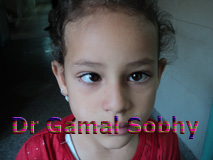
In patients like this
girl, the amblyopia
treatment should be started. However, the odds of success are
reduced as the child grows older. Many authors prefer to
wait for the amblyopic therapy to be successful,
others prefer the surgical alignment followed by
amblyopic therapy.
This
child could benefit from recession of the right
medial rectus and resection of the right lateral rectus. Another
option would be bimedial rectus recession. This
is the patient after BMR recession.
| Pre |
Post operative |
 |
 |
.jpg)